|
|
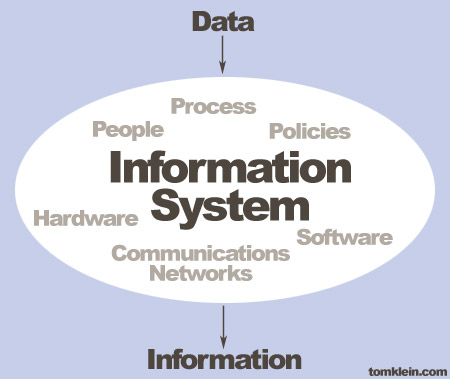 An Information System is an organized combination of process, people , policies, hardware, software, and communications networks for the purpose of tranforming data into information. An Information System is an organized combination of process, people , policies, hardware, software, and communications networks for the purpose of tranforming data into information.Diagram by Tom Klein
When I explain to my students what Information Systems are, I begin by breaking down the term into two definitions - Information and Systems:
Information:
What is the difference between data and information? Data is raw facts or measurements about a particular transaction, event, person, place, or thing. Information is the meaningful synthesis of data. Information incorporates multiple data points in an attempt to make sense of data, and to provide insight into the trends of where the data points are heading. For example, a stock analyst might look at two year's worth of closing price data for a particular stock. The analyst will then add more data about historical events that pertain to the stock. Finally the he or she will apply formulas to perform calculations on the data which will result in an opinion about where the stock is heading, and whether clients should buy, hold, or sell. This opinion is considered information.
Systems:
A System is a set of interrelated components, within a defined framework, that operates together to acheive a common set of objectives. Systems can be made of of other systems. Examples of a system include a grandfather clock, a car engine, the heating system in your home, and the method by which your order is processed at a fast-food restaurant. In business, a system can be used to produce a product and deliver it to market.
The systems concept is at the heart of Management Information Systems and helps us understand technology concepts, application functions, development processes, and management practices.
At its most fundamental level, a system accepts inputs, which it then processes and transforms into a specified and expected output. For example a home heating systems takes input from you when you select your desired room temperature. It combines this information with additional input about the current room temperature. It then transforms this data into instructions to the furnace about when to begin heating the room, and when to stop heating the room. The output is regulated amount of heat that produces the expected room temperature. This heating example also demonstrates the role of control and feedback. The thermometer in the thermostat provides feedback about the the amount of heat produced, and the regulator portion of the thermostat provides control by monitoring the feedback and evaluating when the heat should be turned on and off to maintain the desired temperature.
When you stop and think about it, a corporation itself is a large system. It takes in resources such as people, money, materials, land, and energy. It then makes use of business processes to transform these inputs into goods, services, and profits.
Information System:
Now that we explored individually what Information is, and what a System is, its time to put the two together. An Information System is an organized combination of process, people, policies, hardware, software, and communications networks. The goal of an Information Systems is to transform data into information, and to capture, store, transform, and disseminate this information throughout an organization. Early examples of information systems include the U.S. postal service, Wells Fargo wire service, AT&T telephone systems, library card catalogs, the Internet, e-mail. Here is a description of each component of an Information System:
- Process is the planned and agreed upon procedures of how all the components interact with each other.
- People are the employees, contractors, and other workers who contribute judgement and control.
- Polices are the guidelines that put constraints on component interaction and on the transformation process.
- Hardware are equipment such as desktop computers, laptop computers, blackberries, file servers, applications servers, printers, scanners, etc.
- Software are things like operating systems, spreadsheets, word processors, web browsers, presentation software, and various business applications.
- Communications Networks include local area networks, wide-area networks, the Internet, and telephone systems
Information Technology:
Information Technology is the individual hardware, software, network, and data management components necessary for an Information System to operate.
- Hardware examples include devises such as desktop computers, laptop computers, blackberries, file servers, applications servers, printers, scanners, etc.
- Software examples include operating system software (ie. Mac OS, Unix, Windows), spreadsheet applications, word processors, web browsers, presentation software, and various business applications such as SAP, PeopleSoft, SalesLogix, etc.
- Networks examples include switches, routers, and wiring necessary to support data communications between individual hardware devices.
- Data management examples include database management systems, data architecture design systems.
Through the creation of valuable Information Systems, Information Technology is helping businesses improve efficiency and effectiveness of their processes, decision making, and workgroup collaboration.
The Fundamental Role of Information Systems in Business:
The fundamental role of Information Systems in business is to support business processes by enhancing effectiveness and efficiency in functional areas such as resource procurement, invoicing, accounts payables, general ledger, order entry, sales generation, marketing, and human resources.
Information Systems can also support decision making by providing transparent and summarized information in all functional areas.
Finally, Information Systems can support competitive advantage by supporting innovation and reducing the cost of doing business. This can include the introduction of self-service technology to increase volume while reducing the cost of delivery. Early examples include Automatic Teller Machines. Later examples include e-commerce websites for online shopping.
Information Systems Evolution and Trends:
-
1950s and early 60s - Information Systems were confined to general accounting and basic record keeping.
-
1960s and 70s - Management began to make use of computer generated reports for decision making.
-
1980s - Interactive decision support systems became available for management to create their own ad-hoc reports.
-
1990s - Strategic information systems began to give executives insight into knowledge such as competitive market share. Expert systems provided information that executives needed that they might not specifically query for. Executive information systems began to present consolidated information about critical information in all functional areas. End-user computing provided productivity and collaborative systems for all business levels.
-
2000s - E-business and e-commerce emerged as a way for businesses to integrate business partners and customer directly into their information systems and processes via the Internet and web technologies.
The common thread in the evolution of Information Systems is integration. Specifically the way we have enabled specialized and independent systems to exchange information to form larger systems. This evolutions began with the automation of basic Accounting functions. Other business functions were then automated and eventually integrated to enable a holistic view and control over the enterprise. This integration then reached back to suppliers, and forward to retailers to provide efficiencies and precision in the entire supply chain logistics. Finally, customers themselves became integrated directly into businesses through the advent of electronic commerce.
E-Business:
E-Business is the use of Internet-based technology to enable business process, collaboration, and commerce within a company, with its customers, and with its business partners such as suppliers and retailers. Here are some typical terms used to describe e-business concepts.
-
The Internet is used to communicate and collaborate with customers. This use is often called B2C (Business to Customer).
-
Intranets are used for B2B (Business to Business) communication to business partners.
-
Collaboration Systems are used for internal communications and to support coordination, and collaboration among internal business teams.
-
Electronic Commerce or E-Commerce is the act of buying, selling, and marketing products and services over the Internet.
Challenges for Information Technology:
Success in business depends not just on the quantity of technology used, but also on the quality of the technology and how effectively it is incorporated into the fabric of an enterprise. Quality technology is the result of successful implementations of efficient IT solutions that ethically achieves competitive advantages. This requires the skills and experiences of IT professionals working in partnership with business leaders.
-
Successful implementations of Information Systems is not simply a matter of introducing new technology into a business and assuming that efficiencies will follow. A typical information system implementation can involve the integration of multiple functional areas; and this can result in significant process and cultural changes for a business. The successful implementation must have a business sponsor and must aligned with operational or managerial objectives. Consider an Enterprise Resource Planning (ERP) system, which allows an organization to perform most of their key business functions through a common systems that is implemented across most major areas of a business. Failures can occur if IT tries to lead this type of initiative without the cross functional support of the entire company. Successful ERP implementations are typically achieved only when the project has high-level sponsorship and buy-in form all functional levels.
-
Developing IT Solutions is a large part of the IT executive role. These new solutions are typically introduced in the form of new applications. IT executives must learn how to propose new ways of using information technologies. They must be equally skilled at execution on these proposals, and that requires managing development efforts.
-
Ethics has become a larger concern as Information Systems encompass all areas of business and contain potentially harmful information if misused. IT executives must consider what uses of information technology might be considered improper, irresponsible, or harmful to others.
|
|
