|
|
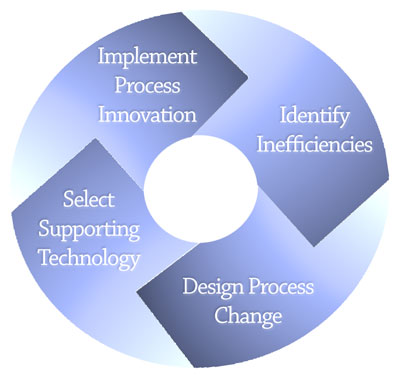 The Process-Oriented Innovation Cycle© is a model that seeks to improve operational efficiencies by planning for process change, and then implementing supporting technology. The Process-Oriented Innovation Cycle© is a model that seeks to improve operational efficiencies by planning for process change, and then implementing supporting technology.Diagram by Tom Klein
by Tom Klein
Implementing new technology is not an end in itself. Rather it should be though of as an ingredient in what I call the Process-Oriented Innovation Cycle, where the goal is to improve the overall efficiency of a company through continuous process and workflow improvements. I have successfully used this approach for many years to deliver innovation that targets ineffective processes and workflows, and then utilizes technology tools to support all required changes. The illustration to the right shows how the four phases of the cycle feed into each other. Here is a is a brief description of each phase:
Identify Inefficiencies
Operational inefficiencies are often first identified by a business unit, but are often articulated through a perceived box-solution that a vendor is pitching or a product that a colleague is using. Whether the solution is appropriate or not is difficult to access in this early phase, but it is often great fuel for discussions that will help get determine where the inefficiencies lie and what the process innovation goals might be.
Design Process Change
Process changes need buy-in from all parties involved, and require a plan so that the changes are implemented with minimal disruption. The use of cross-functional teams are an effective way to discover and build consensus about what processes are associated with operational inefficiencies. Theses teams can can collaborate and design process improvements. In many cases this will also involve brokering agreements between multiple departments to simplify the information that flows between them.
Select Supporting Technology
Once we know which business units are involved, and what the new processes and workflows will look like, we can begin to build a list of requirements for new technology. Sometimes current database systems can be reconfigured to accommodate the new workflows, but in other instances a computerized system might not exist and must be created. There are often times where the issue is not a lack of systems, but an over-abundance of systems; and in these cases several systems might have to be integrated or consolidated to support the flow of information between business units.
Implement Process Innovation
The implementation process requires part project management, and part old-fashion hand-holding. This is where the team commits to making the process changes they agreed upon and timeframes are established. Systems are developed, tested, staged, and acceptance tested. When done right, the business will not think of the effort as the software installation project. But rather as the project to bring product to market faster, or to reduce inventory, or to increase revenue.
|
|
|
