|
|
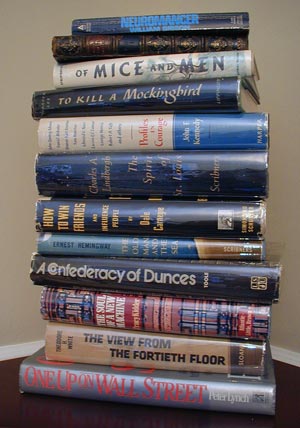 Tom Klein's Favorite Books Tom Klein's Favorite Books
Here is a short list of some of my favorite books.
Neuromancer by William Gibson
William Gibson coined the word cyberspace, and this novel published in 1984 eventually put the term into the mainstream. It's striking how much the Internet has grown to become similar to Gibson's version of cyberspace. I think this book influenced much of the Internet's cultural evolution.
Extraordinary Popular Delusion and the Madness of Crowds by Charles MacKay
A must-read for anyone following any sort of market. Written in 1841 about historical periods of mass excitement and recklessness mania, when "whole communities suddenly fixed their minds upon one object, and go mad in its pursuit; that millions of people suddenly become simultaneously impressed with one delusion, and run after it, till their attention is caught by some new folly". This is where I first learned about "Tulipomania" and the 1720 South Seas Bubble. What I took away from this book is that while we have become more sophisticated in our technology and more knowledgeable about the nature of our world, our innate tendencies toward a herd mentality remains undiminished.
Of Mice and Men by John Steinbeck
Classic Steinbeck. Apparently Lenny was based on a character that Steinbeck worked with. But the real-life Lenny didn't kill the boss' girl. But he did kill a foreman and ended up in a mental institution.
To Kill a Mockingbird by Harper Lee
It's been said that everyone has a least one book in them. This was Harper Lee's one and only book, and what an amazing book it is.
Profiles In Courage by John F. Kennedy
The personal stories of American statesmen who were faced with doing the safe thing, or doing the thing they believed was right. Kennedy wrote this while recuperating from back surgery when he was a U.S. Senator. This book was the grand-daddy of what I call the "Candidate Book", and it is now practically a prerequisite for a presidential hopeful to publish one of these before kicking off a campaign. In spite of that, I still like this book. Interesting quote - "Politics merely furnishes one arena which imposes special tests of courage."
The Spirit of St. Louis by Charles Lindbergh
A Pulitzer Prize winning classic about how one man with an idea broke new ground and did something extraordinary. Lindbergh describes how he attracted investors, planned the flight, and built something entirely new - a airplane capable of flying longer than anything that came before it. Only then was he able to complete the first non-stop fixed-wing transatlantic flight between America and mainland Europe.
How to Win Friends and Influence People by Dale Carnegie
First published in 1936, this book is gold standard of self improvement books. Carnegie discusses common sense techniques for handling people such as "don't criticize, condemn or complain"; and "give honest and sincere appreciation." Other advice includes become genuinely interested in other people, smiling, listening, and remembering that a person's name is to that person the sweetest and most important sound in any language.
The Old Man and the Sea by Ernest Hemingway
A seemingly simple story, but highly imaginative and masterfully written. Hemingway at his best.
A Confederacy of Dunces by John Kennedy Toole
Toole created a character that is funny and loveable, and at the same time loathsome. Toole wrote the book in the 1960's, but committed suicide before it was eventually published in 1980. Toole's mother got the book in front of Walker Percy, and Percy had the book published by Louisiana State University. The book took off from there and eventually won the Pulitzer Prize for Fiction.
The Soul of a New Machine by Tracy Kidder
Required reading in grad school. Pulitzer Prize winner. Tracy Kidder chronicled the real-life efforts of engineers to build Data General's first 32-bit computer. I love Kidder's explanation of integrated circuits:
"...Other devices then in existence could do the same work, but transistors are superior. They are solid. They have no cogs and wheels, no separate pieces to be soldered together, it is as if they are stones performing useful work. They are durable, take almost no time to start working, and don’t consume much power. Moreover, as physicists and engineers discovered, they could be made very small, indeed microscopic, and they could be produced cheaply in large quantities."
The View from the Fortieth Floor by Theodore White
The novel is about a man who is running a failing magazine company in the 1950's. The magazines' advertising base is being eroded by a new technology called Television. As the magazines continue to bleed money, he is pressured into folding his magazines in order to save the company's other none-magazine divisions that are still profitable. The book not only provides unique insight into the golden age of magazine publishing, but also provides some foreshadowing and perspective about the challenges the magazine industry faces today as the Internet destroys the barriers of content distribution and allows virtually anyone to be a publisher.
One Up on Wall Street by Peter Lynch
One of the first investment books I ever read. Still one of my favorites. Lynch ran the highly successful Magellan Fund from 1977 until 1990. A main premise of the book is that we should invest in what we know.
A Brief History of Time by Stephen Hawking
Stephen Hawking is a science legend, and he does an excellent job explaining concepts such as quantum mechanics, string theory, and the big bang theory. The early editions have a great introduction by Carl Sagan.
The World is Flat by Thomas Friedman
This is essential reading for anyone deciding on a career path, and is especially pertinent to college students who will begin their professions on a globally flat playing field. Friedman describes our new networked world where services and processes are distributed across the globe in places where they can be performed most efficiency and effectively. The new skills for tomorrow's leaders will be collaboration, creativity, and the ability to innovate using a wide variety of geographically dispersed resources.
Being Digital by John Negroponte
This book was highly insightful in 1993 at the dawn of the Internet Age. Today, this classic not only remains valid, but is validated by how far we have moved from a world based upon atoms to a world based upon digital bits. We have truly witnessed parts of our physical world disappear as they became largely digital. CD collections have been replaced by MP3s; photos are viewed, stored, and organized on laptops; letters have been replaced by e-mail; newspapers have been replaced by the web; and books are being replaced by eReaders. Even our individual identity and social interactions are being defined online. We really are becoming digital beings as Negroponte predicted. My favorite quote from the book - "We will socialize in digital neighborhoods in which physical space will be irrelevant and time will play a different role." Sounds like Twitter and FaceBook to me.
The Peter Principle by Laurence J. Peter
"Students of Freud, Potter, and Parkingson will be fascinated by this satirical examination of man's tendency to escalate himself to oblivion at his level of incompetence."
|
|
