|
|
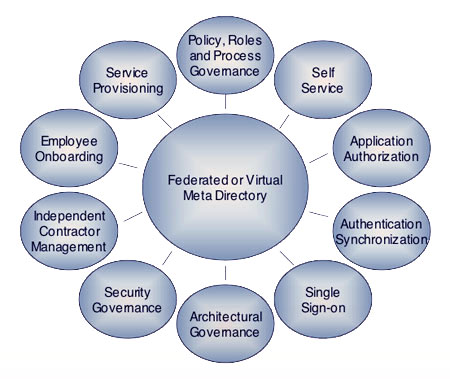 The many components of Identity Management can be combined to fuel the logisitcs of an ERM (Employee Resource Management) system. The many components of Identity Management can be combined to fuel the logisitcs of an ERM (Employee Resource Management) system.Diagram by Tom Klein
by Tom Klein
Identity Management is often misunderstood in many companies. It tends to be confused with one or two of its component products and depending on the component, it becomes the responsibility of IT Infrastructure, IT Security, or Compliance.
This component view is good for vendors because it makes it is easy to commoditize and sell single purpose products that are simply installed, configured, and rolled-out without too much involvement from the business units. But unfortunately single focus components such as tools for Self-Service, Provisioning, Authentication, and Authorization have become ends to themselves rather than the means to achieve the more significant benefits of a comprehensive Identity Management system.
The true value of Identity Management comes from looking at all the components as a holistic, enterprise-wide system that can serve as the hub for all employee services, and can even become a critical component in the creation of an ERM (Employee Relationship Management) system - an internal equivalent to the popular CRM (Customer Relationship Management) system. At the heart of an such a system is a single identifying record for each worker that is located in a central Meta Directory. This record is used to track and consolidate all worker interactions across all company data - thus enabling companies to have accurate, real-time visibility into every employee and contractor activity, including access to all company resources, and all transactions through company systems.
An Identity Management system can provide a complete central view of each worker; beginning with the basics such as his or her name, department, office location, phone number, email address, and direct supervisor. It can then provide expanded detail through integration with:
- Inventory systems to show what equipment a worker is using.
- Facilities systems to show identification photo, building access, and current location.
- Travel systems to show if a worker is traveling on business.
- IT systems to show a worker's equipment inventory, level of training, and help desk history.
In this way, an enterprise-wide Identity Management system can lower administration costs, while providing greater control and enhanced visibility over employee and contractor access to internal company resources and services. Identity Management can streamline the employee hiring and termination process, reduce the amount of system logins and passwords per employee, and lower site licensing fees by producing accurate reports of software usage.
But an Identity Management System is not simply a one-way consolidator of information. It can also be a valuable authoritative source for use by other company systems. For example, a workflow system can draw on an Identity Management system to provide photos of people in a process route, and offer information about who is available in the office to perform tasks. An Identity Management System can also manage the unique identifiers necessary integrate traditionally separate systems so that, for example, a call report from a sales system could generate an expense report in a finance system.
Once an Identity Management becomes part of the fabric of enterprise systems, it will be used in new and unanticipated ways to fuel even more internal efficiency and innovation. Companies that embrace Identity Management can often feel more efficient than their peers. Employees and contractors are more productive and inspired once they are freed from mundane tasks such as filling out redundant forms and spreadsheets, and managing multiple logins and passwords in disconnected systems. A well designed Identity Management can set the tone for efficiency, innovation, and success.
|
|
